Showing posts with label Chemistry. Show all posts

Thursday, 25 September 2014

Scientists Generate Renewable Propane Using Bacteria

Researchers Engineer Gut Bacteria to Generate Renewable Propane 
Researchers used Escherichia coli to interrupt the biological process that turns fatty acids into cell membranes, channeling the fatty acids along a different biological pathway so that the bacteria made engine-ready renewable propane instead of cell membranes.
The development is a step towards commercial production of a source of fuel that could one day provide an alternative to fossil fuels.
Propane is an appealing source of cleaner fuel because it has an existing global market. It is already produced as a by-product during natural gas processing and petroleum refining, but both are finite resources. In its current form it makes up the bulk of LPG (liquid petroleum gas), which is used in many applications, from central heating to camping stoves and conventional motor vehicles.
In a new study, the team of scientists from Imperial College London and the University of Turku in Finland used Escherichia coli to interrupt the biological process that turns fatty acids into cell membranes. The researchers used enzymes to channel the fatty acids along a different biological pathway, so that the bacteria made engine-ready renewable propane instead of cell membranes.
Their ultimate goal is to insert this engineered system into photosynthetic bacteria, so as to one day directly convert solar energy into chemical fuel.
The results of the study are published in the journal Nature Communications.
Dr Patrik Jones, from the Department of Life Sciences at Imperial College London said: “Although this research is at a very early stage, our proof of concept study provides a method for renewable production of a fuel that previously was only accessible from fossil reserves. Although we have only produced tiny amounts so far, the fuel we have produced is ready to be used in an engine straight away. This opens up possibilities for future sustainable production of renewable fuels that at first could complement, and thereafter replace fossil fuels like diesel, petrol, natural gas and jet fuel.”
The scientists chose to target propane because it can easily escape the cell as a gas, yet requires little energy to transform from its natural gaseous state into a liquid that is easy to transport, store and use.
“Fossil fuels are a finite resource and as our population continues to grow we are going to have to come up with new ways to meet increasing energy demands. It is a substantial challenge, however, to develop a renewable process that is low-cost and economically sustainable. At the moment algae can be used to make biodiesel, but it is not commercially viable as harvesting and processing requires a lot of energy and money. So we chose propane because it can be separated from the natural process with minimal energy and it will be compatible with the existing infrastructure for easy use” added Dr Jones.
Using E. coli as a host organism, the scientists interrupted the biological process that turns fatty acids into cell membranes. By stopping this process at an early stage they could remove butyric acid, a nasty smelling compound that is an essential precursor for propane production.
To interrupt the process, the researchers discovered a new variant of an enzyme called thioesterase which specifically targets fatty acids and releases them from the natural process. They then used a second bacterial enzyme, called CAR, to convert butyric acid into butyraldehyde. Finally, they added a recently discovered enzyme called aldehyde-deformylating oxygenase (ADO), which is known to naturally create hydrocarbons, in order to form propane.
Previous attempts to use the ADO enzyme have proved disappointing as scientists have been unable to harness the natural power of the enzyme to create cleaner fuel. But the scientists at Imperial discovered that by stimulating ADO with electrons they were able to substantially enhance the catalytic capability of the enzyme, and ultimately produce propane.
The level of propane that the scientists produced is currently one thousand times less than what would be needed to turn it into a commercial product, so they are now working on refining their newly designed synthetic process. Dr Jones said: “At the moment, we don’t have a full grasp of exactly how the fuel molecules are made, so we are now trying to find out exactly how this process unfolds. I hope that over the next 5-10 years we will be able to achieve commercially viable processes that will sustainably fuel our energy demands.”
This research was funded by a grant from the European Research Council.
Publication: Pauli Kallio, et al., “An engineered pathway for the biosynthesis of renewable ​propane,” Nature Communications 5, Article number: 4731; doi:10.1038/ncomms5731
Source: Gail Wilson, Imperial College London
Image: Imperial College London,src http://scitechdaily.com

Copper Foam Provides a New Way to Turn CO2 into Useful Chemicals

A team of researchers at Brown University’s Center for Capture and Conversion of CO2 have discovered that copper foam could provide a new way of converting excess CO2 into useful industrial chemicals, including formic acid.
Copper Foam Could Provide a New Way of Converting Excess CO2 into Useful Industrial ChemicalsProvidence, Rhode Island (Brown University) — A catalyst made from a foamy form of copper has vastly different electrochemical properties from catalysts made with smooth copper in reactions involving carbon dioxide, a new study shows. The research, by scientists in Brown University’s Center for the Capture and Conversion of CO2, suggests that copper foams could provide a new way of converting excess CO2 into useful industrial chemicals.
The research is published in the journal ACS Catalysis.
As levels of carbon dioxide in the atmosphere continue to rise, researchers are looking for ways to make use of it. One approach is to capture CO2 emitted from power plants and other facilities and use it as a carbon source to make industrial chemicals, most of which are currently made from fossil fuels. The problem is that CO2 is extremely stable, and reducing it to a reactive and useful form isn’t easy.
“Copper has been studied for a long time as an electrocatalyst for CO2 reduction, and it’s the only metal shown to be able to reduce CO2 to useful hydrocarbons,” said Tayhas Palmore, professor of engineering and senior author of the new research. “There was some indication that if you roughen the surface of planar copper, it would create more active sites for reactions with CO2.”
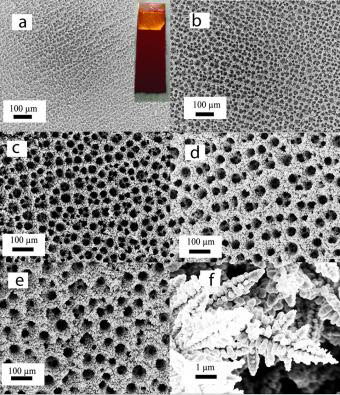
Copper foam, which has been developed only in the last few years, provided the surface roughness that Palmore and her colleagues were looking for. The foams are made by depositing copper on a surface in the presence of hydrogen and a strong electric current. Hydrogen bubbles cause the copper to be deposited in an arrangement of sponge-like pores and channels of varying sizes.
After depositing copper foams on an electrode, the researchers set up experiments to see what kinds of products would be produced in an electrochemical reaction with CO2 in water. The experiments were performed by Sujat Sen and Dan Liu, graduate students in chemistry working in Palmore’s lab at Brown’s School of Engineering.
The experiments showed that the copper foam converted CO2 into formic acid — a compound often used as a feedstock for microbes that produce biofuels — at a much greater efficiency than planar copper. The reaction also produced small amounts of propylene, a useful hydrocarbon that’s never been reported before in reactions involving copper.
“The product distribution was unique and very different from what had been reported with planar electrodes, which was a surprise,” Palmore said. “We’ve identified another parameter to consider in the electroreduction of CO2. It’s not just the kind of metal that’s responsible for the direction this chemistry goes, but also the architecture of the catalyst.”
Now that it’s clear that architecture matters, Palmore and her colleagues are working to see what happens when that architecture is tweaked. It’s likely, she says, that pores of different depths or diameters will produce different compounds from a CO2 feedstock. Ultimately, it might be possible to tune the copper foam toward a specific desired compound.
Palmore said she’s amazed by the fact that there’s still more to be learned about copper.
“People have studied electrocatalysis with copper for a couple decades now,” she said. “It’s remarkable that we can still make alterations to it that affect what’s produced.”
The work in the study is part of a larger effort by Brown’s Center for the Capture and Conversion of CO2. The Center, funded by the National Science Foundation, is exploring a variety of catalysts that can convert CO2 into usable forms of carbon.
“The goal is to find ways to produce some of the world’s largest-volume chemicals from a sustainable carbon source that the Earth not only has in excess but urgently needs to reduce,” said Palmore, who leads the center. “This is a way for us as scientists to begin thinking of how we produce industrial chemicals in more sustainable ways and control costs at the same time. The cost of commodity chemicals is going nowhere but up as long as production is dependent on fossil fuels.”
The Center for Capture and Conversion of CO2 is a Center for Chemical Innovation funded by the National Science Foundation (CHE-1240020).
Publication: Sujat Sen, et al., “Electrochemical Reduction of CO2 at Copper Nanofoams,” ACS Catal., 2014, 4 (9), pp 3091–3095; DOI: 10.1021/cs500522g
Source: Kevin Stacey, Brown University
Image: Palmore lab/Brown University.src http://scitechdaily.com